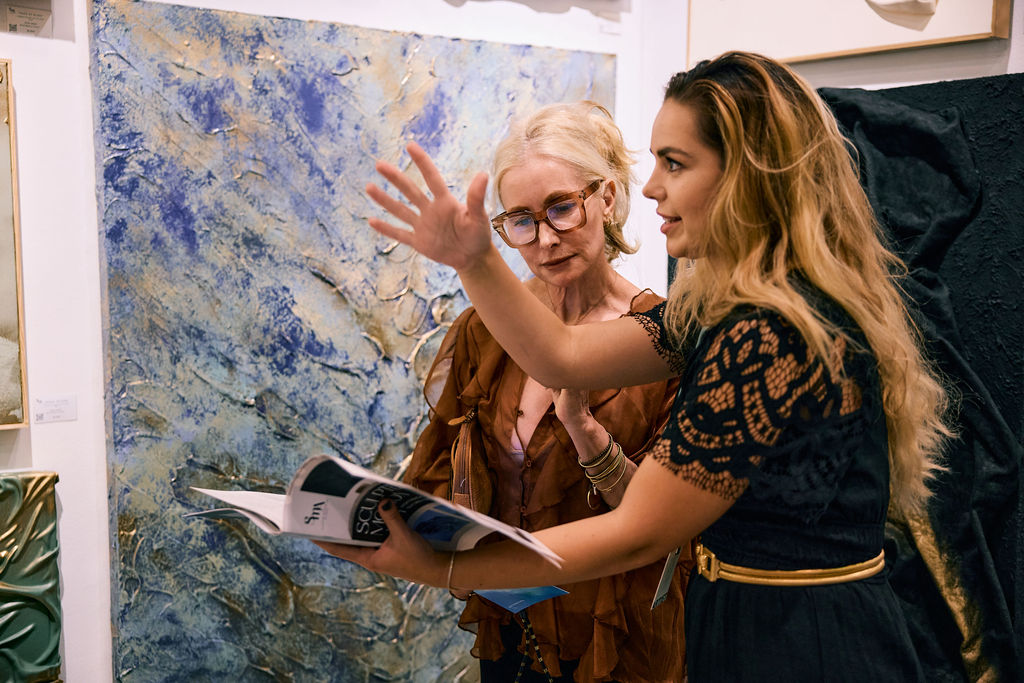
There’s a particular kind of quiet that happens in a gallery. People slow their walk, tilt their heads, and murmur ‘interesting’ before moving on, not because they don’t have something to say, but because they’re not sure it’s worth saying out loud.
Here’s the truth: it’s always worth saying. Talking about art with confidence isn’t about knowing art history or memorizing the names of movements. It’s about trusting what you notice, having a few simple ways to describe it, and asking questions that come from real curiosity. That’s the whole skill.
This guide walks you through how to build that confidence in three stages. Before you even step through the doors, while you’re standing in front of the work, and after the fair ends and the booths come down.
Before the Fair: Get to Know Your Own Taste
Confidence at an art fair doesn’t start at the fair. It starts at home, before you’ve seen a single piece.
Do a quick self-audit. Think about the art you’ve already responded to without trying, a photo you screenshotted, a painting you stopped in front of at a museum, something on a friend’s wall you kept glancing at. Chances are, a pattern’s already there. You just haven’t stopped to notice it.
Ask yourself a few simple questions:
- Do I gravitate toward color, or toward quiet and muted tones?
- Do I want art that matches my space, or art that challenges it a little?
- Am I drawn to realism, abstraction, or something in between?
- Is there a mood I keep coming back to such as calm, bold, chaotic, warm?
Try the empty wall exercise. Walk through your own home and notice the spaces that feel unfinished. This could be a hallway that needs something, or a wall above the couch that’s been blank for a year. Walking into a fair with a specific space in mind can help a lot. Instead of browsing passively, you’re looking for a piece that belongs somewhere. That shift alone will make you feel more purposeful and self-assured the moment you arrive.
During the Fair: Finding the Words
Looking at art is easy. Talking about it out loud is where people can maybe get a bit nervous. Here’s how to make it easier.
Describe what you notice, not what you think you’re supposed to say. Skip “it’s interesting” and reach for something concrete instead. Try finishing one of these:
- “This reminds me of ___.”
- “The color makes me feel ___.”
- “I keep looking at the way they used ___ (texture, scale, light, negative space).”
- “This feels loud / quiet / heavy / weightless to me.”
None of these require expertise. They just require paying attention to your own reaction and saying it out loud. Disliking something is a real opinion too. You don’t need to like everything to sound confident, you can also say why something isn’t for you.
Ask the artist something real. The best conversations happen when you ask about the how and why behind a piece, not just “how long did this take?” A few starting points:
- “What made you start this piece?”
- “Is there a moment or place this came from?”
- “What do you want someone to notice first?”
After the Fair: Keep the Thread Going
Your interest in art doesn’t have to end the moment the booths come down. In fact, this is where the most confident collectors are made, not in a single afternoon, but in the follow-through.
- Follow the artists you connected with, so you can watch how their work evolves.
- Revisit that empty wall you identified before you came. Did you find the piece for it? If not, what would you look for next time?
- Explore ways to keep discovering art between Fairs, SaatchiArt.com, collector communities, and curated platforms make it easy to stay in the habit of looking, even from home.
The Real Takeaway
Being the most interesting person in the room at an art fair was never about sounding like an expert. It’s about being willing to say what you actually see, ask a question because you’re genuinely curious, and trust that your taste is allowed to be exactly what it is, informed by you, not by anyone else.